


2015 - 2017
New OARS WEEL for Decamethylcyclopentasiloxane (D5) is available for public comment. The 45-day public comment period will end on November 28, 2015. Please send comments to Ann Parker at ann.parker@uc.edu by this date.
Save the Date!! for the NEW Risk Assessment Seminar Series. TERA has stared a new monthly seminar series on risk assessment. Join us the 3rd Thursday of each month to learn about various "hot" topics in risk assessment. The seminar is located in room G17 in the Kettering Laboratory Building (160 Panzeca Way) on the Medical Campus at the University of Cincinnati from 11:00am-noon. Our first seminar is November 20th, on "Using Causal Analysis for Evaluating Environmental and Health Issues" by Dr. Charles Menzie, the Global Executive Director for the Society of Environmental Toxicology and Chemistry (SETAC) and also a Principal with Exponent Inc.
Don't Believe Everything Thats on a Blog: The Facts About Dr. Dourson and C8.
A recent blog article appeared at http://ringoffireradio.com/2015/10/01/dupont-expert-testifies-that-his-relationship-to-industry-is-like-jesus-hanging-out-with-prostitutes/ in regards to Michael Dourson's testimony as a fact witness at a recent trial. The article defames the goals and intentions of the independent science-based organization Toxicology Excellence for Risk Assessment (TERA). The article’s statements about TERA do not follow from the evidence presented at the trial, nor from information readily available on TERA’s website. Moreover, the article is mistaken or omits relevant information about TERA in every instance. If you choose to read the blog article, enclosed in total below the bullets below, please note that:
- TERA was hired by a contractor for the State of West Virginia to establish a health-based screening level for C8 in 2002. TERA scientists got an award from the State of West Virginia for their efforts. The blog statement that TERA was "hired by DuPont to establish a health-based screening level of the toxin known as C8,” is not correct.
- The lawyer at the trial directed Dr. Dourson to to confirm that “selected" work was industry funded. However, the lawyer only selected industry work, leaving out 2/3rds of TERA's work done for government and other nonprofits---as the TERA website shows (https://tera.org/about/FundingSources.html). Such omission seems unreasonable.
- The blog article wrote that "Dr. Dourson stated he likened his relationship to the industry as 'Jesus hanging out with prostitutes.'” Actually, the lawyer at the trial asked this as a question to which Dr. Dourson answered affirmatively no. TERA’s scientifically independent and neutral policy does not allow it to advocate for any particular product or chemistry, or industry, government or NGO position. Once again, the blog article is in error.
- The blog article wrote that "that in some years more than 50% of its work is “industry or industry-related.” However, in only 2 out of 21 years was TERA's industry work more than 50%; for the other 19 years, government work predominated. Once again, such omission seems unreasonable. The blog article wrote that the "company’s Board of Directors includes Vice-Chair Gregery S. Romshe of the Procter & Gamble Company.” However, TERA’s Board of Directors has 12 folks, of whom 2 are from industry, 3 from universities, 3 are consultants, and 4 are from NGOs. Once again, such omission seems unreasonable.
- Michael Dourson was subpoenaed as a fact witness to describe TERA's work for the State of West Virginia. He attended this trial as an employee of TERA. The blog statement that “Dr. Dourson was hired to defend DuPont against the claims of Carla Bartlett," is also incorrect.
- Budinsky RA, Schrenk D, Simon T, Van den Berg M, Reichard JF, Silkworth JB, Aylward L, Brix A, Gasiewicz T, Kaminski N, Perdew G, Starr TB, Walker NJ, Rowlands JC. (2014). Mode of action and dose-response framework analysis for receptor-mediated toxicity: the aryl hydrocarbon receptor as a case study. Critical Reviews in Toxicology.
- Elcombe CR, Peffer RC, Wolf DC, Bailey J, Bars R, Bell D, Cattley RC, Ferguson SS, Geter D, Goetz A, Goodman JL, Hester S, Jacobs A, Omiecinski CJ, Schoeny R, Xie W, Lake BG. (2014). Mode of action and human relevance analysis for nuclear receptor-mediated liver toxicity: A case study with phenobarbital as a model constitutive androstane receptor (CAR) activator. Critical Reviews in Toxicology.
- Corton JC, Cunningham ML, Hummer BT, Lau C, Meek B, Peters JM, Popp JA, Rhomberg L, Seed J, Klaunig JE. (2014). Mode of action framework analysis for receptor-mediated toxicity: the peroxisome proliferator-activated receptor alpha (PPARα) as a case study. Critical Reviews in Toxicology.
- Andersen ME, Preston RJ, Maier A, Willis AM, Patterson J. (2014). Dose-Response Approaches for Nuclear Receptor-Mediated Modes of Action for Liver Carcinogenicity: Results of a Workshop. Critical Reviews in Toxicology.
2014
SRA Travel Award Winner. Alison Willis won a Society for Risk Analysis Student/New Researcher Travel Award to this year's Annual Meeting in Denver, Colorado. She will be presenting a poster on data from her recent Master's Project thesis and publication.
New Toxicologist Formerly of the USEPA. Dr. Jeanelle Martinez joined TERA in October 2014. She has more than 15 years experience in toxicology and risk assessment. Her expertise includes analysis of health risks for chemical warfare agents and pesticides.
New Senior Toxicologist at TERA. Dr. Patricia McGinnis has joined TERA as a Senior Toxicologist. She has worked in the field or risk assessment and toxicology for over 28 years.
Society for Risk Analysis (SRA) Annual Meeting in Denver. Several of TERA's staff are presenting at this year's SRA annual meeting. Click here for the list of TERA presentations and posters. Stop by our booth during the meeting.
Invited speaker at Food Packaging Summit. Dr. Mike Dourson was invited to give a talk on "Advances in Assessing Food Additive Safety" at the SPI Food, Drug and Cosmetic Packaging Materials Committee, Food Packaging Summit in New Orleans, Louisiana on November 10-12, 2014.
West Virginia Spill Peer Review - WV TAP Reer Review of the MCHM Screening Level -
TERA has selected and convened a panel of five experts to review and discuss the available toxicology data and the scientific support for the West Virginia Screening Level established at 10 parts per billion (ppb). The panel discussed the initial starting value of 1 part per million (1,000 ppb) established by the US CDC and then considered if the additional safety factor applied by the State of West Virginia was protective.
Link to Workshop Page
Workshop Support for Styrene Information Research Center (SIRC)– Dr. Michael Dourson chaired the science panel of a workshop on modes of action of lung tumors in mice from Exposures to Styrene Ethylbenzene, and Naphthalene. The workshop was organized by the Styrene Information Research Center (SIRC) and was held in Cincinnati Ohio on September 17, 2013. View the workshop page here. TERA prepared the panel’s report, which is available here.
OARS WEEL for D4 Open for Public Comment. The OARS-WEEL on Octamethylcyclotetrasiloxane (D4) is now open for public comment, the comment period ends December 19, 2013.
TERA is Expanding Ecologically! We are pleased to announce our expanded suite of ecological and environmental science services, complementing our strong historical reputation in health risk assessment and industrial hygiene. Our staff now includes scientists with broad experience in ecotoxicology, environmental fate, and ecological risk and hazard assessment of chemical ingredients, products and by-products. Check out the webpage for more information on our Ecotoxicology & Ecological Risk Assessment Program.
Presentation at the 2014 GMA Science Forum on TOX21. TERA has been invited to give a presentation at the 2014 GMA science forum on Tox21 on April 7-8,2014 in Washngton, DC. TERA will present on TOX21 at the New Approaches in Toxicology Assessments session. Information on last year's meeting can be found here.
TERA Participates in Mouse Lung Tumor MOA Workshop. TERA staff participated in a workshop on September 17, 2013 organized by the Styrene Information & Research Center (SIRC) and focused on the MOA involving chemically-similar aromatic hydrocarbons and included discussion of available data, including recent studies in knockout and humanized mice. SIRC organized this workshop with the purpose of seeking opinions from independent risk and mode of action experts on a hypothesized mode of action for mouse lung tumors.
Guidance for Contaminated Sites: Trichloroethylene Risk Assessment and Management - Free Webinar from the Alliance for RIsk Assessment, Monday, November 4, 2013. Registration and more information are available at http://allianceforrisk.org/Projects/TCE.html
First OARS-WEEL is now available. The OARS-WEEL for trans-1-Chloro-3,3,3-trifluoropropylene (HCFO-1233zd(E)) is now available online.
A. Willis, J.T. Oris. 2014. Acute photo-induced toxicity and toxicokinetics of single compounds and mixtures of polycyclic aromatic hydrocarbons in zebrafish. [Manuscript accepted to Environmental Toxicology and Chemistry Journal; available online].
Presentation on KidsChemicalSafety.org. Ms. Patricia Nance gave a presentation at the monthly Alliance for Chemical Safety meeting in Cincinnati, OH. The presentation was an introduction to the KidsChemicalSafety.org website.
Happy birthday to the “citation classic” Dourson and Stara (1983) paper on Uncertainty Factors, which turns 30 this year!
Endocrine Disruptors Screening Program (EDSP) Publication Now Available. The US EPA Endocrine Disruptor Screening Program (EDSP) was implemented with the first round of test orders in 2009 and this screening has yielded large volumes of data derived from numerous laboratories and on a variety of chemical classes. TERA worked with a multiple stakeholder organizing committee to organize and conduct a workshop in April 2013 to share insights and experience of practitioners and laboratories conducting the screening. Over 200 people participated in the workshop and a publication is now available on the ALTEX website at http://www.altex.ch/Online-first.95.html and in PubMed PMID:24114257.
Four Publications from Nuclear Receptor Workshop Now In Press.
Four manuscripts from the September 2010 Nuclear Receptor Workshop organized by TERA are now in press in Critical Reviews in Toxicology. The workshop explored the development of dose-response approaches to nuclear receptor-mediated liver cancer, within a Mode of Action (MOA) Human Relevance Framework (HRF). The papers are scheduled for the January 2014 issue.
Doug Lee Stays at TERA. Doug Lee started as a research intern in 2012. He graduated from the University of Cincinnati with a Bachelor of Science in Biological Sciences (2009) and Environmental Studies (2012). He was hired in February 2012 as a Research Assistant at TERA, assisting senior level scientists with data assessment and formatting on a broad range of projects.
2013
Dr. Michael Dourson on the radio!
On behalf of Kids + Chemical Saftey Dr. Dourson will be doing a live radio interview at 5:40pm ET on Wednesday, September 18, 2103 on station 1470 AM, WMGG (in the Tamp Bay, FL area) as part of their Health, Wealth & Wisdom daily radio show. The segment will be on the benefits and risks of fluoride in drinking water (see related fluoride articles). You can also listen to the show live by going through www.healthwealthandwisdom.org.
WEEL Values are now available on the OARS website. The American Industrial Hygiene Association Guideline Foundation announced that the transfer of its Workplace Environmental Exposure Levels® (WEELs) development process to Toxicology Excellence for Risk Assessment under the Occupational Alliance for Risk Science initiative (TERA OARS) has been finalized. The table of WEEL values is now available at https://tera.org/OARS/. Click here for a copy of the press release.
The Alan Weinrich Scholarship for Studies in Occupational Health: The Occupational Alliance for Risk Science (OARS) initiates a new graduate scholarship program. For more details visit the website at https://tera.org/OARS/weinrichscholarship.html.
WORKSHOP: Beyond Science & Decisions: From Problem Formulation to Dose Response – Workshop VI will held May 28-30 at the EPA Potomac Yard building in Arlington, Virginia. The workshop will be broadcast via webinar. A keynote talk will be delivered by U.S. EPA’s Ken Olden, along with several enlightening updates on related efforts, and case study presentations of risk methods. Agenda and workshop information are available here. Webinar Registration is available here.
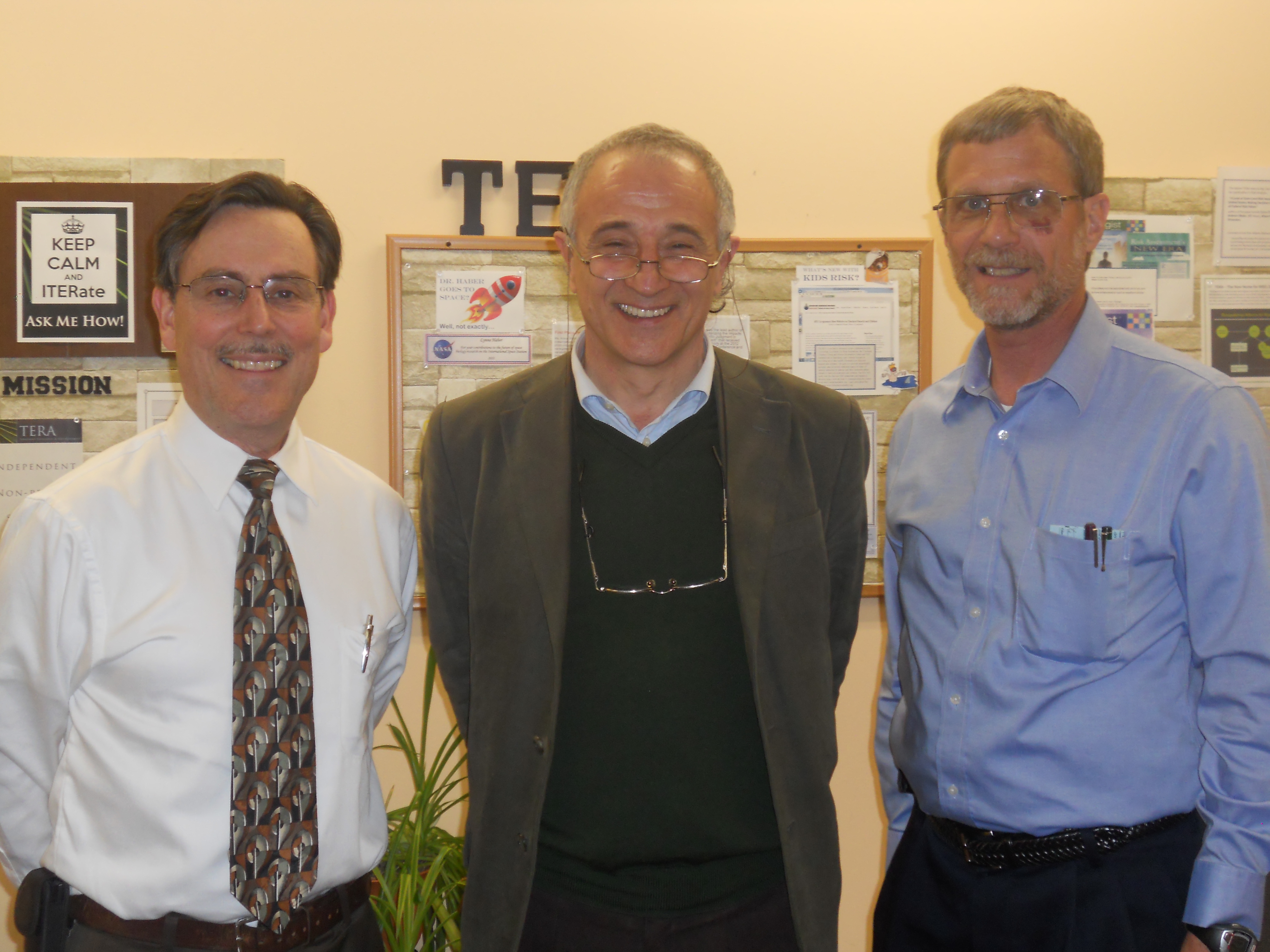
Special Guest from Italy Presents at TERA. TERA enjoyed by a special presentation from Professor Gian Paolo Rossini from the Università di Modena e Reggio Emilia, Modena, Italy entitled "Proteomic Approaches to the Characterization of Modes of Action of Toxic Mixtures." Professor Rossi was visiting with Dr. Dave Mattie, USAF. Click here for a picture of Michael Dourson, Gian Paolo Rossini, Dave Mattie after the presnetation.
Hot off the press! Latest publication from TERA and colleagues. A Look at State-Level Risk Assessment in the United States: Making Decisions in the Absence of Federal Risk Values. Effio DG, Kroner O, Maier A, Hayes W, Willis A, Strawson J. Risk Analysis, Vol. 33, No. 1, 2013. http://onlinelibrary.wiley.com/doi/10.1111/j.1539-6924.2012.01842.x/full
Dr. Lynne Haber participated in an expert panel meeting on cell and tissue culture with NASA. The purpose of the meeting was to identify ground-based and in-flight culturing, processing and analysis capabilities that are needed to fully utilize the International Space Station National Laboratory for animal cell science and tissue engineering.
Post-Doctoral Assembly of the Society of Toxicology. Dr. Andrew Maier of TERA presents on the advantages of careers in the non-profit sector in a session sponsored by the Post-Doctoral Assembly of the Society of Toxicology. Click here for a picture of the assembly.

Dr. Lynne Haber has been elected vice president elect of the Ethical, Legal and Social Issues Specialty Section of SOT. This group provides a forum in which to discuss the ethical implications of results from our science as well as the resulting legal and social implications. More information at http://www.toxicology.org/ISOT/SS/ELSI/index.asp.
Dr. Sue Ross joins TERA! Sue is a board-certified occupational medicine physician and has been practicing medicine for about 20 years. She also holds a law degree and has been the Occupational Medicine Residency Director at the University of Cincinnati (UC) and on the UC Master of Public Health program faculty (teaching environmental health and public health law).
2012
TERA Staff Attended the Society of Toxicology (SOT) Meeting with 11 Presentations. The annual SOT meeting was held in San Antonio, Texas on March 10-14, 2013. Check TERA's activities held during the meeting www.tera.org/about/sot.html.
2013 Toxicology and Risk Assessment Conference (TRAC) Postponed. Due to circumstances beyond our control, the TRAC (Toxicology and Risk Assessment) Conference for 2013 has been postponed until 2014. Please check the website, http://www.cdc.gov/niosh/conferences/TRAC/default.html, for updates.
Dose-Response Assessment Boot Camp to be held May 6-10, 2013. The 2013 Boot Camp course will be held on May 6-10, 2013 in Cincinnati, Ohio. Registration is now open! Details and the registration form can be found on the course webpage.
TERA Selected as a Global Host Institution. The Society of Toxicology (SOT) selected TERA to host Dr. Sri Noegrohati of Gadjah Mada University, Indonesia, under its 2013 Global Senior Scholar Exchange program. The program aims to increase the global impact of toxicology by working to strengthen toxicology programs and capacity at universities in developing countries. TERA will assist Dr. Noegrohati in developing training modules for undergraduate and graduate students that integrate knowledge of toxicology testing and risk assessment.
Dr. Lynne Haber Organizes Joint (ELSI & RASS) Webinar on Journals Requirements for Release of Supporting Data. The Ethical, Legal and Social Issues (ELSI) and Risk Assessment Specialty Sections (RASS) of SOT are jointly sponsoring a webinar on February 13th at 3:00PM (EST) entitled: Should Journals Require the Release of Supporting Data as a Condition for Publication? A diverse panel will present perspectives in a roundtable discussion format. For additional information, go to http://www.toxicology.org/ISOT/SS/RiskAssess/index.asp (for presentations click "Downloads" section of the RASS homepage).
Ms. Jaqueline Patterson Receives SRA Presidential Recognition Award. Jaqueline was gievn the Society for Risk Analysis (SRA) Presidential Recognition Award at the 2012 Annual Meeting held in San Francisco, California. The award was for her oustanding contributions to the Conferences & Workshops Committee.
Ms. Patricia Nance Co-Chair's SRA's Workshops at Annual Meeting Committee. Patricia has been accepted as this year's co-chair for the Society of Risk Analysis's Workshops at Annual Meeting Subcommittee. She co-leads this committee with Dr. Jay Zhao of the U.S. EPA.
Dr. Lynne Haber Visits Turkey. Lynne taught a 1-day overview of risk assessment and recent developments in conjunction with the Turkish Society of Toxicology meeting. She gave a lecture at the Turkish SOT meeting, and gave a lecture at Yeditepe University in Istanbul.
Dr. Bernard Gadagbui Ventured to Africa. Bernard taught a 5 day course
on risk assessment, primarily tp training officials from the National Agency for Food and Drug Administration and Control (NAFDAC) and academia. He also met with Ghana EPA, Food and Drugs Board, Ghana Standards Authority, and University of Ghana regarding TERA’s risk assessment training.
Presentation on Genotoxic Impurities. Dr. Reena Sandhu presented a talk entitled “An Introduction to Genotoxic Impurities” at the Canadian Association of Professional Regulatory Affairs (CAPRA) symposium on Regulatory Toxicology and Safety held on October 15, 2012. The talk was held at the Prince Westin Hotel in Toronto, Ontario, Canada. For more information on the conference, please visit the CAPRA website at http://www.capra.ca/
International Programme on Chemical Safety (IPCS) values added to ITER! We recently began adding IPCS data to ITER. We added data for the following chemicals: Acrolein, Aroclor 1016, Aroclor 1248, Azodicarbonamide, Carbon Disulfide, Chloral Hydrate, Chloroform, Cumene, Diethylene glycol dimethyl ether, and 1,2,3 - Trichloropropane. The ITER entries for these chemicals are based on the IPCS CICAD documents. Azodicarbonamide and Diethylene glycol dimethyl ether are new additions to ITER.
TERA helps Local Tri-State Family. TERA's scientists looked at records including environmental exposures, veterinary records and medical records.Click here to read the news story.
ARA's Work on Contaminated Site Issues. The Alliance for Risk Assessment (ARA) has taken on 2 important projects dealing with chemical specific contaminated sites. More infromation is available on ARA's website at https://www.allianceforrisk.org.
.
The ARA's Dose Response Framework is now on the National Library of Medicine' Enviro-Health Links. The framework provides a “roadmap” to guide the risk practitioner from problem formulation through dose-response evaluation techniques. The framework is available at on the ARA website at www.allianceforriskassessment.org or contact Dr. Michael Dourson, Dourson@tera.org.
Chemical Risks in Children's Toys? This is the feature essay for the national release of KidsChemicalSafety.org. Click here for the press release.
TCEQ Risk Values now on ITER. TERA recently added a new column to ITER, entitled “TCEQ – Texas Commission on Environmental Quality”. This column contains data from the Texas Commission on Environmental Quality. The values are based on TCEQ's Development Support Documents (DSD)
Beyond Science & Decisions: Workshop III Meeting Report now available. The Workshop III meeting report is now available. The Report presents key conclusions from the panel discussion on three key themes for Workshop III: problem formulation, mode of action, and endogenous/background exposures. It also presents the results of panel discussions on case studies and plans for next steps.
DART Webinar is Going International. The "Practioner's Guide to Developmental and Reproductive Toxicology" 4-hour webinar is scheduled for December 3 (US) and December 4 (Australia/New Zealand/Japan/Korea/Taiwan/China). Click here for the details and to register.
Press Release - October 3, 2012
Response to a report released by the Center for Progressive Reform.
A Look at State-Level Risk Assessment in the United States: Making Decisions in the Absence of Federal Risk Values (Effio et al. 2012) to be published in Risk Analysis. How do state agencies make risk management decisions when there’s no federal guidance? Using trichloroethylene as a case study, our investigation finds a variety of approaches, and a variety of risk values across the country. We outline options for improving information sharing between state organizations, including the SEARCH database of state risk agencies. Article available at: http://onlinelibrary.wiley.com/doi/10.1111/j.1539-6924.2012.01842.x/abstract
TERA Scientists keep actively engaged in current health science symposia and workshops to support the protection of public health. Upcoming presentations include:
- October 18-19, 2012: FutureTox: Building the Road for 21st Century Toxicology and Risk Assessment Practices, an SOT-sponsored Contemporary Concepts in Toxicology meeting. Dr. Andrew Maier of TERA will serve as Session Chair on Risk Assessment Road Maps. http://www.toxicology.org/ai/meet/cct_futuretox.asp
- October 28-31, 2012: AIHA Fall Industrial Hygiene Conference. Dr. Andrew Maier will be presenting in a workshop on the Continuum of Exposure Guidance Resources: Relating Hazard Bands, DNELs, and OELs. See: http://www.aihafallconference.org/Pages/Default.aspx
- November 1-3, 2012: Isocyanates and Health, Past, Present and Future. Dr. Andrew Maier will be presenting on a session on biomarkers and leading a session on models for research collaboration. See: http://www.isocyanates2012.org/
First Place Presentation Awarded. Ms. Alison Willis was awarded first place in graduate student presentations for her presentation, "Species sensitivity to photo-induced toxicity in sheepshead minnow (Cyprinodon variegates) and zebrafish (Danio rerio), and inter-specific variability in LC50s for three phototoxic PAHs (fluoranthene, pyrene, anthracene) in zebrafish (Danio rerio)" at this year's Ohio Valley Chapter Society for Environmental Toxicology and Chemistry meeting.
TERA President joins Toxicology Education Foundation. Dr. Michael Dourson has joined the Board of Trustees for the Toxicology Education Foundation (TEF). TEF's mission is to encourage, support, and promote charitable and educational activities that increase the public understanding of toxicology. http://www.toxedfoundation.org/index.html
Mr. Douglas Lee joins TERA as a Science Intern and will be with us through February 2013. Doug graduated from the University of Cincinnati with a Bachelor of Science in Biological Sciences (2009) and Environmental Studies (2012). He recently completed an internship study program at the Environmental Protection Agency in the toxicology department reviewing and editing reports for submission to the IRIS database
Agenda now available for Beyond Science & Decisions: From Problem Formulation to Dose Response Workshop 5. Speakers and topics for November 2 webinar have been announced at https://www.allianceforrisk.org/ARA_Dose-Response.htm.
TERA Board of Director, Mike Freemont sets the half-marathon world record. Mike Fremont, 90 yrs old, set a pending single age world record on Sunday, August 19, at the Little Miami Half Marathon in Morrow, Ohio. Fremont completed the 13.1 mile course in two hours, 56 minutes, and 26 seconds. The previous world half marathon record for a 90-year-old man stands at three hours, 21 minutes, and 27 seconds, set by Wiktor Burgren of Goteborg, Sweden in 2002. Click here for the full news article.
4-Part Series in The Synergist. Dr. Andrew Maier, participated with other members of the AIHA Risk Assessment Committee, to develop a 4-part series entitled “Risk Assessment’s New Era” for The Synergist. The series highlights research and policy initiatives that are shaping the future of risk assessment in the industrial hygiene profession.
- Part 1: Challenges for Industrial Hygiene
(http://www.aihasynergist-digital.org/aihasynergist/201204#pg27)
- Part 2: Evolving Methods and Future Directions
(http://www.aihasynergist-digital.org/aihasynergist/201205#pg51)
- Part 3: Vision of the AIHA Risk Assessment Committee
(http://www.aihasynergist-digital.org/aihasynergist/20120607#pg31)
- Part 4: Roadmap for Integrating Risk And Decisions Making into Industrial Hygiene (http://www.aihasynergist-digital.org/aihasynergist/201208?pg=35#pg33)
ITER Mentioned in Nature Magazine. TERA's International Toxicity Estimates for Risk Assessment database (www.tera.org/ITER) was mentioned in an article in Nature (Vol. 489, 6 Sept 2012, page 27-28), as an example of how the U.S. EPA's Integrated Risk Information System (IRIS) should be updated to include risk values developed by international public-health agencies, by other health agencies in the United States and by private groups. http://www.nature.com/nature/journal/v489/n7414/full/489027a.html
TERA–The New Home for WEEL Development. The Board of the American Industrial Hygiene Association (AIHA) has approved a proposal to house the Workplace Environmental Exposure Levels (WEEL) development activities within TERA under the recently formed Occupational Alliance for Risk Science (OARS). TERA will be working with AIHA and the WEEL Committee on a smooth transition of the WEELs to OARS. TERA will be providing free access to any newly development WEELs, and direct links to current WEELs available from AIHA. More information on the OARS can be found at www.tera.org/OARS
Award Winning Poster: TERA's Andrew Maier was the lead author of a poster entitlted "Characterizing the Impacts of Uncertainty and Scientific Judgment in Exposure Limit Development" that received the Best of Conference honors at the 2012 American Industrial Hygiene Conference and Exposition. For a copy click here.
A Look at State-Level Risk Assessment in the United States: Making Decisions in the Absence of Federal Risk Values (Effio D, Kroner O, Maier A, Hayes W, Willis A, Strawson J) will be published in Risk Analysis. How do state agencies make risk management decisions when there’s no federal guidance? Using trichloroethylene as a case study, our investigation finds a variety of approaches, and a variety of risk values across the country. We outline options for improving information sharing between state organizations, including the SEARCH database of state risk agencies. Article available at: http://onlinelibrary.wiley.com/doi/10.1111/j.1539-6924.2012.01842.x/abstract
DART Webinar is Going International. The "Practioner's Guide to Developmental and Reproductive Toxicology 4-hour webinar that took place in June was a success and is now being scheduled for this fall/winter.
Another Successful ITERate Meeting held August 22-23. Hexavalent chroimium and perchlorate were the chemicals reviewed at the August meeting. Details of the meeting will be available soon. ITERate is open for any interested organization in having their human health risk assessment values from published peer-reviewed journal reviewed and loaded onto the International Toxicity Estimates for Risk (ITER) (www.tera.org/ITER; http://toxnet.nlm.nih.gov/). Contact nance@tera.org or dourson@tera.org to submit your publication or to volunteer as a reviewer.
TERA Named Twice on SciVerse ScienceDirect's Top 25 Hottest Articles List. Staff at TERA have 2 journal articles among the list of the “Top 25 Hottest Articles List” for the Regulatory Toxicology & Pharmacology Journal for first quarter 2012. The quarterly list is the most read articles, counted by article downloads on SciVerse ScienceDirect. TERA’s results are:
#6: Correlation of chemical structure with reproductive and developmental toxicity as it relates to the use of the threshold of toxicological concern. Regulatory Toxicology and Pharmacology, Volume 62, Issue 1, February 2012, Pages 160-182. Laufersweiler, M.C.; Gadagbui, B.; Baskerville-Abraham, I.M.; Maier, A.; Willis, A.; Scialli, A.R.; Carr, G.J.; Felter, S.P.; Blackburn, K.; Daston, G.
#23:Human health risks from mercury exposure from broken compact fluorescent lamps (CFLs). Regulatory Toxicology and Pharmacology, Volume 62, Issue 3, April 2012, Pages 542-552. Nance, P.; Patterson, J.; Willis, A.; Foronda, N.; Dourson, M.
TERA Board of Director, Philip Tobin Named Director of Mercer Univerisity's Physician Assistant Program. Philip Tobin, a 17-year physician assistant and a former assistant professor at Harding University, has been named the new chair and program director of Mercer University’s Department of Physician Assistant Studies. Prior to this position, Tobin was assistant professor and assistant clinical director of the Physician Assistant program at Harding University, where he chaired the institutional review board charged with ensuring the university’s research compliance involving human subjects. Tobin was also on the medical staffs at the Arkansas Department of Corrections and Whitaker Medical locums in Texas. Click here for the full news release.
TERA Staff Headed Down-Under. Dr. Michael Dourson and Ms. Patricia Nance are travelling to Australia in July to present at SRA’s World Congress on Risk. They will also conduct the Dose-Response Assessment Boot Camp training session, along with Dr. Bette Meek (Univ. of Ottawa, McLaughlin Institute), Ms. Julie Fitzpatrick (USEPA), and Ms. Ann Parker (TERA) for 40 professionals. Michael and Patricia will also travel to New Zealand to meet with ESR and representatives from the New Zealand Ministry of Health and various other government agencies.
TERA Board Director, Mike Fremont, Awarded 45th Annual Little Miami Legacy Award.Mike Fremont has spent decades as an advocate for the Little Miami River system. Little Miami Inc. honored his 40 years of dedication with the Little Miami Legacy Award. It is given to a member who exemplifies the mission of Little Miami Inc. to restore and protect the Little Miami Wild and Scenic River. Mike is also a founding member of Rivers Unlimited, the oldest statewide rivers organization in the nation. For more on the newspaper article click here.
TERA Teams with ACTRA to offer a 4-Day Dose-Response Assessment Course in Sydney, Australia. TERA and the Australasian College of Toxicology and Risk Assessment Inc (ACTRA) teamed up to offer a 4-day course on dose-response assessment. It will be held July 23-26 in Syndey, following the World Congress on Risk. For more information check out the course webpage.
Dr. John Reichard promoted to Research Assistant Professor in the Dept. of Environmental Health at UC. Dr. Reichard is a staff Toxicologist and TERA and holds a dual appointment at the University of Cincinnati in the Department of Environmental Health.
Dr. Michael Dourson appointed to EPA's Science Advisory Board. TERA's President, Michael Dourson, has been appointed to EPA's Science Advisory Board (SAB). The SAB is the senior scientific/technical advisory committee for the EPA. Its objective is to provide independent advice and peer review to EPA's Administrator on the scientific and technical aspects of environmental issues.
Alliance for Risk Assessment Dose Response Framework now on the National Library of Medicine' Enviro-Health Links. The ARA's Dose Response Framework provides a “roadmap” to guide the risk practitioner from problem formulation through dose-response evaluation techniques. Methods are systematically organized into three categories; qualitative decision, quantitative screening decision, and in-depth assessment. Within each category, the risk assessor is guided to methods that address key issues, such as Mode of Action assessment, vulnerable population assessment, endogenous/background exposure, and data integration. Methods interlink with case studies to illustrate real-world application, and summaries that outline the minimum data requirements, and evaluate the method’s ability to address human variability, sensitive populations, and background exposures or responses.
http://allianceforrisk.org/Workshop/Framework/ProblemFormulation.html
TERA scientists coauthor paper selected by SOT's Risk Assessment Specialty Section. TERA scientists were coauthors on a paper selected by the Risk Assessment Specialty Section as one of the top publications demonstrating an application of risk assessment: Rhomberg, L.R., J.E. Goodman, L.T. Haber, M. Dourson, M.E. Andersen, J.E. Klaunig, B. Meek, P.S Price, R.O McClellan, and S.M. Cohen. 2011. Linear low-dose extrapolation for noncancer health effects is the exception, not the rule. Critical Reviews in Toxicology. 41(1): 1–19. Available at http://informahealthcare.com/toc/txc/41/1
Book Published by former TERA Research Assistant. Ace McArleton, former TERA research assistant from 1999-2000, is the author of the forthcoming book:
The Natural Building Companion: A Comprehensive Guide to Integrative Design and Construction, which can be found http://www.chelseagreen.com/bookstore/item/the_natural_building_companion
TERA Rolls Out Risk Value Review Program To Bring ITER to all Stakeholders
ITERate is a new program from TERA to review human health risk assessment values from published peer-reviewed journals for loading onto International Toxicity Estimates for Risk (ITER) (www.tera.org/ITER; http://toxnet.nlm.nih.gov/). The inclusion of these toxicity values on ITERallows for easier access to new data, allows information to reach a worldwide audience in a user friendly format, helps to foster use of the latest science, and promotes collaboration among risk assessors. Contact nance@tera.org or dourson@tera.org to submit your publication or to volunteer as a reviewer
WEBINAR: Practioner's Guide to Developmental and Reproductive Toxicology. Dr. Ray York and Dr. Lynne Haber will be presenting a 4-hour webinar on June 13, 2012. It will cover issues related to potential for reproductive and developmental effects of chemicals or products. For more details go to the Webinars page at www.tera.org/webinars
Alliance for Risk Assessment seeking nominations for Beyond Science & Decisions Panel. Panel members are sought from a diversity of affiliations and areas of expertise, particularly biology/toxicology, risk assessment, and statistical/modeling. Panel members will be chosen by the ARA Steering Committee (https://www.allianceforrisk.org/ARA_Steering_Committee.htm) and will serve for 2-3 years. Please send nominations and a CV Oliver Kroner at Kroner@tera.org by January 26, 2012. The first meeting of the standing panel is envisioned to be held two days in the period of May 21-24th, at the Texas Commission on Environmental Quality in Austin, Texas.
Dr. Andrew Maier co-authored the cover article of the April issue of the Synergist – published by the American Industrial Hygiene Association - on the future of risk assessment in occupational health. Dr. Maier is Director of TERA and a certified industrial hygienist and board certified toxicologist. The article highlights trends in occupational risk assessment and growing opportunities for technology transfer with methods used in allied risk assessment specialties.
Dr. Michael Dourson participating in NAS workshop (April 18-19) on individual variability. Dr. Dourson will be giving a presentation on “How Individual Variability Is Currently Factored into Risk Assessment/Regulation/Decision Making”. The workshop will explore new and innovative approaches to characterizing individual variability arising from endogenous, biological factors and its impact on susceptibility to risks from environmental exposures. For more information on the workshop or to register for the workshop,check out the website at http://nas-sites.org/emergingscience/workshops/individual-variability/
Lynne Haber to participate in SOT CCT workshop May 8-11, 2012. The goal of the SOT “Contemporary Concepts in Toxicology” Meeting: Building for Better Decisions: Multi-Scale Integration of Human Health and Environmental Data (TERA is a co-sponsor) is to bring together scientists from across the exposure-dose-response continuum for both ecological and health endpoints, and from other communities (e.g., clinical/biomedical informatics, defense, intelligence) to discuss the requirements for data accessibility, data storage, data management, data analysis, and data interoperability that are becoming increasingly critical for computational modeling, research, and regulatory decision making. For more infomation check out the meeting website at: https://www.toxicology.org/ai/meet/cct_b4bd.asp
New Publications from TERA Staff
Mwanza, JC; Lyke, DF; Hertzberg, RC; Haber, L; Kohrman-Vincent, M; Li, R; Pan, Y; Lyles, RH; Simmons, JE; MacMillan, JK; Zehr, RD; Swank, AE; Herr, DW. (2012) Cholinesterase inhibition and depression of the photic after discharge of flash evoked potentials following acute or repeated exposures to a mixture of carbaryl and propoxur neurotoxicology. Neurotoxicology. In press.
Maier, A; Kohrman, M; Hertzberg, R; Dourson, M; Haber, LT; Allen, B. (2012) Dose-response options for assessment of mammary tumors in acrylamide-treated rats: re-evaluation based on mode of action. Food and Chemical Toxicology. Accepted.
Rider, CV; Dourson, M; Hertzberg, RC; Mumtaz, MM; Price, PS; Simmons, JE. (2012) Incorporating nonchemical stressors into cumulative risk assessments. Toxicol Sci. Online Publication:. http://toxsci.oxfordjournals.org/content/early/2012/02/16/toxsci.kfs088.abstract.
Dr. Reena Sandhu joins TERA! Dr. Sandhu is a pharmaceutical toxicologist with over 10 years of experience working in senior scientific or consulting roles in the pharmaceutical and biotechnology industries. Her expertise includes all aspects of support in these business sectors from drug discovery and development through to post-marketing product support. She has also authored dozens of scientific publications and provided scientific review for in-license candidates and novel products. In recent years, Dr. Sandhu has worked as a toxicological risk assessor for pharmaceutical, personal healthcare and consumer product companies. Dr. Sandhu completed a PhD in Physiology at the University of Toronto, Canada and post-doctoral training in Cardiology at St. Michael's Hospital in Toronto. Throughout her training, she received multiple competitive research awards. She is also a Diplomate of the American Board of Toxicology.
2012 Toxicology and Risk Assessment Conference (TRAC) was held on April 30-May 3, 2011 at the Wingate by Wyndham Hotel in West Chester, Cincinnati, Ohio. This 4-day meeting focused on topics in risk assessment practice including hydraulic fracturing (fracking). This year’s theme was Biochemical Interactions: from Molecules to Man. An overview of current research, methodologic, and practice issues that are the focus of risk assessment efforts in various Federal agencies, academic institutions, industry, and other organizations will be highlighted. For more information the website is http://www.cdc.gov/niosh/conferences/TRAC/default.html.
New Fellows:
Dr. Sue Ross joins TERA as a Fellow. Dr. Ross, MD, JD, is a board-certified occupational medicine physician. She has experience in clinical and consulting occupational/environmental health activities in varied settings, including corporate employee health, medical monitoring programs and litigation support activities. Dr. Ross served as the Occupational Medicine Residency Program Director at the University of Cincinnati (UC) from 2004 through 2011. She held faculty appointments related to her teaching activities in the UC College of Medicine Departments of Environmental Health and Public Health Sciences and in the UC College of Law. Dr. Ross is the founder and president of Environmental and Occupational Health Consultants, Inc. Based on her training and experience in these roles she has a robust history of evaluating the effects of chemical exposures on human health outcomes and providing critical analyses of human effects data for assessing health risk. In past affiliations with TERA, Dr. Ross has provided peer review of medical management guidelines for diagnosis and treatment protocols for chemical exposures during emergency events.
Dr. Ray York is now a TERA Fellow. Dr. York is a board-certified toxicologist with almost 30 years of experience in the field of toxicology, specializing in reproductive and developmental toxicology. He has served as a study director on over 700 GLP safety evaluation studies, and published over a 100 manuscripts, review articles, book chapters and abstracts, and has been an invited speaker at international conferences. Dr. York earned his Ph.D. in Toxicology at the University of Cincinnati Medical Center, Kettering Laboratory and completed a two-year postdoctoral fellowship at the Children’s Hospital Research Foundation in Cincinnati, in the area of developmental toxicology.
Mercury and Compact Fluorescent Lightbulbs (CFLs) Paper Accepted for Publication. TERA worked with the New Zealand Ministry of Health on a project regarding the health risks associated with mercury exposure from CFLs.
Nance, P; Patterson, J; Willis, A; Foronda, N; Dourson, M. (2012) Human Health Risks from Mercury Exposure from Broken Compact Fluorescent Lamps. Reg. Tox. Pharm. Volume 62, Issue 3 , April 2012, Pages 542–552.
Michael Dourson participates in group publication on perchlorate. Michael Dourson joined five other esteemed scientists, Gail Charnley, Thomas Cluderay, George Gray, Tom Roberts and Nancy Stoner in publishing a Forum on perchlorate published in The Environmental Forum (www.eli.org).
"The Perchlorate Debate: Is the Chemical Worth Regulating". 2011. The Environmental Forum. Nov/Dec. Vol. 28(6), page 46-53. (pdf)
Scientists from P&G and TERA publish TTC paper. The P&G/TERA Team compiled a large database of reproductive and developmental toxicity data. The data were then analyzed to calculate Thresholds of Toxicological Concern (TTC values). The calculated TTC values were compared to existing TTC values. Based on the results of this comparison, we confirmed that the current TTC values can be applied to the reproductive and developmental endpoints.
Laufersweiler, MC; Gadagbui, B; Baskerville-Abraham, IM; Maier, A; Willis, A; Scialli, AR; Carr, GJ; Felter, SP; Blackburn, K; Daston, G. (2012) Correlation of chemical structure with reproductive and developmental toxicity as it relates to the use of the threshold of toxicological concern. Regul Toxicol Pharmacol. 62(1):160-82.
2011
TERA joins the Interstate Technology & Resource Council (ITRC).
TERA has proudly joined the Interstate Technology & Resource Council (ITRC), a state-led coalition working together with industry and stakeholders to achieve regulatory acceptance of environmental technologies. ITRC consists of 50 states, the District of Columbia, multiple federal partners, industry participants, and other stakeholders, cooperating to break down barriers and reduce compliance costs, making it easier to use new technologies, and helping states maximize resources.

TERA supports the Ontario Ministry of the Environment in Reviewing Science Supporting Air Quality Criteria Development. TERA led a team of scientists supporting work by the Ontario Ministry of the Environment in reviewing the science supporting air quality criteria development. This work is part of a broader OMOE effort to document its process and enhance clarity and consistency for stakeholders. The review is also intended to identify opportunities to refine the methods for developing ambient air quality criteria. As part of this effort, the TERA team conducted a jurisdictional review, considering the approaches used by a variety of jurisdictions in Canada, by US Federal and State agencies, as well as approaches of international and national authoritative bodies. The aim of the review was to identify approaches, issues, and best practices for addressing issues including: 1) factors affecting the choice of averaging times for sampling and setting of air standards; 2) definitions and applications of chronic, subchronic, and acute exposure and effects; 3) uncertainty factors and the interplay between uncertainty factors and the determination of the point of departure; 4) allocation of exposure across routes and consideration of combined exposures; and 5) linear vs. non-linear / threshold vs. non-threshold dose response. The jurisdictional review was followed by a workshop where OMOE scientists discussed with each other and with the TERA team issues related to the jurisdictional review. The workshop participants developed a consensus on best scientific practices to address most of the issues considered, including the development of novel analytical approaches to considering issues such as allocation.
Beyond Science & Decisions: Workshop III. Meeting Report now available
The Workshop III meeting report is now available. The Report presents key conclusions from the panel discussion on three key themes for Workshop III: problem formulation, mode of action, and endogenous/background exposures. It also presents the results of panel discussions on case studies and plans for next steps.
ITERate Second Review Meeting Success – Manganese Oxide ITER file and report uploaded. On June 29, 2011, the ITERate panel determined that the risk value derived in “Proposal for a revised Reference Concentration (RfC) for manganese based on recent epidemiological studies” by Bailey et al. (2009) should be included on the ITER database under manganese oxide. The panel conducted a thorough, systematic discussion of the key data and decisions using the charge questions. Panel members were also asked to note any substantive points or issues to include in the ITER file that they thought would be helpful for the ITER user to be aware of when considering this value. The meeting report and ITERate information can be found at https://tera.org/Peer/ITERReview/index.html, and the ITER database chemical entry at http://iter.ctcnet.net/publicurl/pub_search_list.cfm
TERA's Next Dose-Response Boot Camp. The next Boot Camp will be held September 19-23, 2011 in Cincinnati, Ohio. Class is Monday thru Thursday from 8:00am - 5:00 pm, Friday class will conclude around 2 p.m. Register before August 19th and save $200! This course is a 5-day intensive hands-on training in hazard characterization and dose-response assessment. Beginners through expert toxicological risk assessors will learn advanced methods, as well as enhance their understanding and skills in the basics. Course lectures will be supplemented with daily hands-on application exercises. Interested individuals should have a basic understanding of Toxicology and interest in developing skills in human health risk assessment. Additional logistic information on the course will be on our website at https://tera.org/Global/Bootcamp/index.html within the next few weeks. On-line registration should is also available at https://tera.org/Global/Bootcamp/registration.html.
TERA works with National Library of Medicine to support development of Chemical Hazards Emergency Medical Management (CHEMM) . TERA scientists and staff provide toxicology support and significant contributions to development of a newly released database, the Chemical Hazards Emergency Medical Management: CHEMM (US Department of Health and Human Services). The CHEMM website, hosted and created by the National Library of Medicine (NLM), provides access to comprehensive sets of information via a user friendly interface. In short, CHEMM is a complete one stop resource containing information on planning, preparing for, and responding to, chemical emergencies such as terrorist attacks, transportation spills, industrial explosions, building collapse, and natural disasters. Anticipated users include first responders, first receivers, other health care providers, and planners. CHEMM allows these users to plan for, respond to, recover from, and mitigate the effects of incidents involving chemicals.
45 Organizations Unite to Develop Path Forward from NAS Science & Decisions. Under the Alliance for Risk Assessment, a collaboration of 45 government, industry, academic, and consulting organizations came together to further the conversation set forth by the NAS (2009) Science & Decisions. Twenty-five case studies highlighting problem formulation, mode of action, and background/endogenous risk were presented. Learn more
Look Who's New at TERA. Dr. John Reichard joins TERA as a Staff Toxicologist and holds a dual appointment at the University of Cincinnati in the Department of Environmental Health. Dr. Reichard has doctoral degrees in Molecular Toxicology from the University of Colorado, and Pharmacy from the University of Kentucky. Dr. Reichard’s doctoral project in toxicology focused on the role of oxidative stress in liver disease with an emphasis on the kinetics and metabolism of reactive oxidative intermediates. As part of TERA, Dr. Reichard is contributing his expertise in genomic research to support TERA’s effort to facilitate the application of next generation toxicology methods and approaches in risk assessment
TERA Scientist Selected as Expert for JECFA. Dr. Michael Dourson was selected by the World Health Organization (WHO) to serve as scientific expert for the Joint FAO/WHO Expert Committee on Food Additives (JECFA).
TERA authors chapter in book on toxicogenomics in risk assessment. Toxicogenomics (the application of molecular techniques such as genomics and transcriptomics to the study of adverse effects of chemicals on human health and the environment) is a rapidly growing field. To maximize the utility of these powerful tools, it is important for risk assessors and laboratory researchers to have a common understanding of practical considerations for the application of toxicogenomic data. TERA scientists authored a chapter providing an overview of the use of toxicogenomics in human health risk assessment in a new book addressing practical considerations related to the use of toxicogenomics in risk assessment.
Baskerville-Abraham, I., A. Willis, B. Gadagbui, and L.T. Haber. 2011. Introduction to Human Health Risk Assessment. In: Application of Toxicogenomics in Safety Evaluation and Risk Assessment. John Wiley and Sons Inc., D.R. Boverhof and B. B. Gollapudi, ed.
TERA Collaborations with NIOSH on Methods for Occupational Skin Notations Published. The first article, Dotson et al., presents an overview of a strategy for assignment of hazard-specific skin notations (SK), developed by the National Institute for Occupational Safety and Health (NIOSH). This health hazard characterization strategy relies on multiple SKs capable of delineating systemic (SYS), direct (DIR), and immune-mediated (SEN) adverse effects caused by dermal exposures to chemicals. The second article, Chen et al., evaluated the efficacy of a predictive model utilized by the NIOSH to identify dermal hazards based on potential of systemic absorption compared to hazard assignments based on dermal lethal dose 50% (dermal LD50) or logarithm of octanol-water partition coefficient (log KOW). Both articles are published in the Regulatory Toxicology and Pharmacology and are available online.
G. Scott Dotson, Chen-Peng Chen, Bernard Gadagbui, Andrew Maier, Heinz W. Ahlers and Thomas J. Lentz. The evolution of skin notations for occupational risk assessment: a new NIOSH strategy. http://dx.doi.org/10.1016/j.yrtph.2011.06.002. Available online 20 June 2011.
Chen-Peng Chen, Heinz W. Ahlers, G. Scott Dotson, Yi-Chun Lin, Wei-Chen Chang, Andrew Maier, Bernard Gadagbui. Efficacy of predictive modeling as a scientific criterion in dermal hazard identification for assignment of skin notations. http://you.myipcn.org/science/article/pii/S0273230011001322. Available online 20 June 2011.
"Best of Session" Award at AIHce. TERA authors, Andy Maier and Ann Parker, received a “Best of Session” award for their poster “Application of an Updated Methodology for Deriving Immediately Dangerous to Life or Health (IDLH) Values” presented at the American Industrial Hygiene Continuing Education Conference (AIHce) on May 17, 2011. The poster summarizes the updated methodology for deriving IDLH values using a weight of evidence (WOE) approach, and discusses the challenges encountered when analyzing the data under the new methods. The new methodology will be published as a Current Intelligence Bulletin (CIB) by National Institute for Occupational Safety and Health (NIOSH) once the peer review process is complete.
Dr. Andrew Maier of TERA presents on New Approaches in Occupational Toxicology. Dr. Andrew Maier gave invited presentations on concepts intended to advance the science on several challenging issues in occupational risk assessment. In a session on information resources for industrial hygienists involved in emergency response to chemical incidents he provided a decision framework for identifying and selecting relevant and reliable exposure guidelines. The concept of cumulative risk has continued to gain emphasis for occupational scenarios, and he presented examples of techniques that may allow for early effect biomarkers to serve as a point of integration for cumulative effects of multiple stresses. Such techniques may pave the way for use principles of the Exposome concept to be more fully embraced in IH practice. As part of a special science symposium session on the challenges of assessing health impacts of alternative temporal exposure patterns, Dr. Maier laid out a suite of alternative assessment strategies, including consideration for setting task-based exposure limits. These presentations were given at sessions of the American Industrial Hygiene Conference and Exposition in June 2011 and are available from the AIHA.
Dr. Lynne Haber Participates in International Workshop on the TTC Methodology. Dr. Haber was one of approximately 80 workshop participants, who included representatives from government agencies, academia, NGOs, and industry. The workshop, entitled “Threshold of Toxicological Concern: Scientific Challenges and Approaches” was cosponsored by CEFIC-LRI, ILSI-Europe, the European Partnership for Alternatives to Animal Testing (EPAA), and the International Society of Regulatory Toxicology and Pharmacology. The workshop goals included identifying barriers to broader use of TTC and approaches for overcoming the barriers. The outcome of the workshop will be published in Regulatory Toxicology and Pharmacology.
TERA Scientists Elected to Leadership Positions.
- Dr. Michael Dourson is the current president of the Mixtures Specialty Section of the Society of Toxicology (SOT).
- Dr. Gadagbui is currently the Vice President of the African Society for Toxicological Sciences, a Councilor for Ohio Valley - Society of Toxicology (OVSOT), and Secretary of Ohio Society for Risk Analysis (OSRA). He was also the first and former President of the Toxicologists of African Origin (TAO), a Specialty Interest Group of Society of Toxicology (SOT).
- Dr. Andrew Maier was elected as the incoming Vice-President of the Occupational and Public Health Specialty Section of the Society of Toxicology.
- Dr. Irene Abraham is currently the President of the Society of Toxicology’s Toxicoloists of African Origin (TAO) - Special Interest Group (SIG). She also serves on the SIG-Collaboration Group, and serves as a HOST mentor for SOT’s Committee for Diversity Initiatives Undergraduate Program.
- Ms. Patricia Nance was elected to the Alliance for Chemical Safety's Executive Committee as the Communications Chair. She also serves on the Society for Risk Analysis's World Congress organizing committee.
- Dr. Lynne Haber is the chair of the Dose-Response Specialty Group of the Society for Risk Analysis (SRA).
2011 TRAC Conference. Toxicology and Risk Assessment Conference (TRAC) 2011 will be held April 25-28 in Cincinnati, Ohio.
2010
 TERA’s Lynne Haber serves on IRIS peer review panel
A critical aspect of high-quality assessments is thorough peer review. In support of that goal, Lynne Haber served on the peer review panel for EPA’s IRIS assessment for hexachloroethane. The consolidated meeting notes can be found at
http://cfpub.epa.gov/ncea/iris_drafts/recordisplay.cfm?deid=223043
TERA’s Andrew Maier to Serve as IPA Fellow with NIOSH
One aspect of TERA’s non-profit mission is to enhance risk assessment science through scientific exchange. Consistent with this vision Dr. Maier, TERA’s Director, has accepted a position as a Toxicology Fellow via an Interagency Personnel Agreement with the Education and Information Division of the National Institute for Occupational Safety and Health. Dr. Maier will work at NIOSH on a part-time basis conducting research to further develop methods in occupational risk assessment.
TERA’s Andrew Maier
Presents Perspectives on Risk Data Evolutions to NLM SIS Division
Dr. Maier of TERA gave an invited lecture to the staff of the National Library of Medicine Specialized Information Service. The presentation focused on drivers and transitions in the field of human health risk assessment for environmental chemicals and how these changes in the field may affect information resource use. See Presentation here.
TERA Published OEL Recommendation for the Butter Flavor -
Diacetyl
Diacetyl is a butter flavoring that has been implicated as a cause of lung effects in workers (e.g., popcorn workers lung). TERA conducted an independent evaluation of the current epidemiology and toxicology literature to explore the feasibility of developing an occupational exposure limit (OEL) for diacetyl. TERA presented preliminary findings to numerous organizations, including Federal and State agencies, organized labor groups, and researchers to gain feedback on preliminary findings. The outcome of this outreach effort resulted in an OEL recommendation that has recently been published.
Maier,
A.M., M. Kohrman-Vincent, A. Parker, and L.T. Haber. 2010. Evaluation of concentration-response options for diacetyl in
support of occupational risk assessment.
Reg. Toxicol. and Pharmacol. 58(2): 285-296.
Recognizing a need for improved
communication between state risk agencies, TERA and the Alliance for
Risk Assessment partnered with Diana Effio of Cleveland State
University to reach out to state risk assessors. A comprehensive survey of the states discovered a
need for a centralized source of state agency contact information. To this end, the State Environmental
Agency Risk Collaboration for Harmonization (SEARCH) database of
risk contacts for each state was created. SEARCH
is intended to help the flow of information across organizational
boundaries. Currently in beta stage, SEARCH is
available at https://www.allianceforrisk.org/SEARCH/index.html.
TERA participated in a second Alliance for Risk Assessment
(ARA) workshop on October 11-13, 2010, in Crystal City,
Virginia in tandem with the Federal & State Risk Assessment &
Toxicology Committee. This second meeting in a series was to
extend the work of the National Academy of Science, Silver Book,
effort on improving risk assessment. At this workshop many
different experts views were shared and debated in a highly
collegial fashion, which bodes well for future collaborative work.
TERA’s view of this workshop series, shared by many at the second
workshop, is that:
 Risk assessment requires multiple and differing expert
views in order to chart a credible path forward that adequately
considers regulatory impact. No one type of expertise, or
group, can be expected to have all of the answers.
Risk assessment requires multiple and differing expert
views in order to chart a credible path forward that adequately
considers regulatory impact. No one type of expertise, or
group, can be expected to have all of the answers.
The NAS (2009) and the NAS 2007 reports had many good ideas; any path forward from these and other texts, such as the IPCS MOA human relevance framework and EPA (2005), however, needs clarification, enhancement and pruning with additional thought, debate, and consensus.
The 38 sponsors and collaborators
includes 9 government agencies, 9 industry groups, 7 scientific
societies, 8 non-profit organizations/consortia, and 5 consulting
groups. The complete list of sponsors can be found at: https://www.allianceforrisk.org/ARA_Dose-Response_Sponsors.htm.
Results of the workshop are summarized here.
Michael Dourson, President and Senior Toxicologist at TERA,
gave a presentation at EPA’s IRIS listening session for its “Draft
Toxicological Review of Hexavalent Chromium" on November 18, 2010.
He described the panel of independent experts TERA organized to
evaluate the Cr6 research plan of ToxStrategies to develop Mode of
Action (MOA) information on this chemical's tumorigenicity [link to presentation]. Also in attendance were scientists from the
Environmental Working Group, the Natural Resources Defense Council,
the Environmental Protection Agency, ToxStrategies, the American
Water Works Association, George Washington University, Michigan
State University and Summit Toxicology. TERA’s independent
consultation redirected several aspects of the research plan, some
of which are now coming to fruition. The ongoing research,
described by others at the session, will undergo additional
independent expert review in order to give EPA scientists additional
insights into various approaches for dose response assessment of
this environmentally important chemical. See https://tera.org/Peer/Chromium/Chromium.htm for information about the TERA organized independent expert
review.
Hasegawa, R., H.K. Mutsuko, M.L. Dourson,
A. Parker, L.M. Sweeney, A. Nishikawa, M. Yoshida, A. Ono, A.
Hirose. 2010. Proposal of new uncertainty factor application to derive
tolerable daily intake. Regul. Toxicol. Pharmacol. 2010. 58(2):
237-242.
Dourson,
M. 2010. U-shaped
dose-response curves: implications for risk characterization of
essential elements and other chemicals. Dourson M. J Toxicol Environ Health A. 2010;73(2):181-6.
TERA's Dose-Response Assessment Boot Camp to be held February 7-11, 2011 in Austin, Texas. More details can be found at https://tera.org/Global/Bootcamp/index.html.
Cain, W.S., M.L. Dourson, M.J.
Kohrman-Vincent, and B.C. Allen. 2010. Human Chemosensory Perception of Methyl Isothiocyanate: Odor and
Chemesthesis. Reg. Toxicol. and Pharmacol. 58(2):173-180
Dourson, M.L., M.J.
Kohrman-Vincent, and B.C. Allen. 2010. Dose response assessment for effects of acute exposure to methyl
isothiocyanate (MITC). Reg. Toxicol and Pharmacol. 58(2):181-188
Maier, A.M., M.
Kohrman-Vincent, A. Parker, and L.T. Haber. 2010. Evaluation of concentration-response options for diacetyl in support
of occupational risk assessment. Reg. Toxicol. and Pharmacol.
58(2): 285-296.
Society of Toxicology Council approves TERA as an Affiliate. A
full description of the process is provided at this link http://www.toxicology.org/ms/affiliates.asp.
Lynne
Haber gave a presentation to the Commissioners of the Consumer Product Safety Commission on Risk Assessment and
Children’s Issues. See it here.
Dr. Michael Dourson traveled to Flin Flon, Manitoba in June to present the findings of an expert panel convened by TERA that had reviewed a human health risk assessment (HHRA) for the area surrounding the Hudson Bay Mining and Smelting Company smelter in Flin Flon. Click
here for further details.
Meeting report now available on the Nickel Ion Bioavailability workshop.
Registration for the Toxicology and Risk
Assessment Conference is now open. You
can register for this April 26-29, 2010 event here. For general information about the conference, with a
link to registration, go here.
Dr. Irene Abraham was elected as the VP of
Toxicologists of African Origin (TAO), a special interest group
within the Society of Toxicology (SOT). Her three-year
term that begins May 1, 2010 includes one year of service in each of
the following positions, Vice President, President and
Past-President. One of the many objectives of TAO is to provide
guidance or act as SOT's liaison to other organizations on
toxicological issues that are relevant to populations of African
origin.
Ms. Patricia Nance and Dr. Andy Maier accepted an award on behalf of TERA for “Excellence in Risk
Communication” from the Alliance for Chemical Safety, for
their work on the 2007 Air Toxics Report for
the Hamilton County Department of Environmental Services. Co-authors of the award and co-winners were Deborah Leonard of EQM
and Kenneth Edgell of the Hamilton County Department of
Environmental Services. Congratulations Patricia
and Andy!
Dr. Michael Dourson, President and founder
of TERA is now an SRA fellow. More
details can be found at http://www.sra.org/membership_fellows.php
2009
TERA fellow Dr. Pamela Williams received the Chauncey Starr
Distinguished Young Risk Analyst Award from the Society for Risk
Analysis. This award recognizes a member age 40 years or
younger for outstanding achievement in science or public policy
relating to risk analysis and exceptional promise for continued
contributions to risk analysis.
Alliance for Risk Assessment announces "Beyond Science and Decisions: From Problem Formulation to Dose-Response" workshop series. Workshop I scheduled for March 16-18, 2010.
Derived
Reference Doses (RfDs) for the Environmental Degradates of the
Herbicides Alachlor and Acetochlor: Results of an Independent
Expert Panel Deliberation - submitted for publication to Regulatory
Toxicology and Pharmacology.
Dourson, M.L., M.J.
Kohrman-Vincent, B.C. Allen,
and W.S. Cain.
2009. Dose Response Assessment from Effects of Acute Exposure to Methyl
Isothiocyanate (MITC).
In Press. http://www.elsevier.com/wps/find/authorshome.authors/preprints
Congratulations! Dr. Michael Dourson, President
and founder of Toxicology
Excellence for Risk Assessment has been
awarded the 2009 International Achievement Award by the International Society of
Regulatory Toxicology and Pharmacology. The Society
annually presents an award to an outstanding individual in
recognition of their contributions and achievements in the
resolution of public environmental concerns. ISRTP presents its annual
International Achievement Award to an outstanding individual in
recognition of their contributions and achievements in advancing the
core Mission of the Society --- promoting sound science as the basis
for regulations affecting human health and safety and the
environment. Dr. Dourson joins an illustrious group of recipients of
this award, including Bob Neal, Jeff Carr, John Higginson, Roger
McClellan, Joseph Borzelleca, Curtis Klaassen, Jerry Heckman, Bernie
Schwetz, and Mildred S. Christian.
Dr. Lynne Haber attended the Tenth International Conference on
Environmental Mutagens in Florence Italy . As part of a forum on
“Mutagenic Mode of action for carcinogens: How high is the burden
of proof?” she presented a case study evaluating the mode of action
of acrylamide carcinogenesis, with a focus on tunica vaginalis
mesothelioma
An environmental risk assessment training
workshop at the 7th Congress of Toxicology in Developing
Countries (CTDC) is being supported by NIEHS.
The event will be held September 6-10 in Sun City, South Africa. The
workshop was organized by the African Society for Toxicological Sciences (ASTS) (http://africansocietyfortoxicologicalsciences.org/)  and
co-sponsored by ASTS and Toxicology Excellence
for Risk Assessment (TERA) (https://tera.org/) . Dr. Bernard Gadagbui of TERA will be attending the Congress.
and
co-sponsored by ASTS and Toxicology Excellence
for Risk Assessment (TERA) (https://tera.org/) . Dr. Bernard Gadagbui of TERA will be attending the Congress.
Dr. Lynne Haber attended
and was a rapporteur for a workshop
cosponsored by U.S FDA, USEPA, Health Canada and McLaughlin Centre,
University of Ottawa on modes of action for cancer involving
interaction with DNA: Implications for dose-response analysis
and research. The workshop is expected to result in a
peer-reviewed publication.
Dr. Michael Dourson has been selected as a
Fellow of the Society for Risk Analysis. This honor reflects the major national and
international contributions he has made to the discipline of risk
analysis. The award will be presented at the annual SRA
meeting in Baltimore, Maryland at the Society Luncheon on Tuesday,
December 8, 2009.
TERA is pleased to announce the availability
of the report of a Peer Workshop on Toxicological Assessment and
Development of RfDs for Acetanilide Degradates. The workshop was run under the auspices of the Alliance for Risk
Assessment (ARA), for the purpose of developing Reference Doses
(RfDs) for the degradates: alachlor t-ESA, alachlor t-OXA,
acetochlor t-ESA, and acetochlor t-OXA. The meeting, supported by Monsanto and Dow AgroSciences, was
held on Monday and Tuesday, May 11 and 12, 2009 at the Northern
Kentucky University METS Center located near the Greater Cincinnati
International Airport. The public was invited to
attend and provided written comments. The meeting
report and post meeting panel comments are available here <https://tera.org/ART/Degradates/index.html>
.
Dr. Lynne Haber attended a
meeting of the NoMiracle project (NOvel Methods for Integrated Risk
Assessment of CumuLative stressors in Europe) in Ravenstein, The
Netherlands, and presented on cumulative risk methods in the U.S.
Recent interest in the Integrated Risk
Information System (IRIS) by the U.S. Congress prompted an
invitation by congressional staff to comment. The
attached letter to Congress by Michael Dourson shows one way forward.
Toxicology Excellence for Risk Assessment (TERA) is pleased to
welcome Lisa M. Sweeney, Ph.D., DABT, CHMM to our growing
organization. Dr. Sweeney has a
broad range of experience in the application of toxicology,
chemistry, and engineering to problems in the health and
environmental sciences. She has over 15 years experience in
risk assessment, pharmacokinetics, and biochemical engineering from
a variety of private sector and non-profit backgrounds. Her
experience has focused on the development and refinement of
physiologically-based pharmacokinetic (PBPK) models and their
application to risk assessment and experimental design. She is
an author of over 30 peer-reviewed publications, with 18 as first
author. Dr. Sweeney is a graduate of Case
Western Reserve University and Cornell University, where she earned
bachelor’s and doctoral degrees, respectively, in chemical
engineering. Dr. Sweeney is certified by the American Board of
Toxicology and is a Certified Hazardous Materials Manager. She
has previously served as a councilor for the Society of Toxicology’s
Risk Assessment and Biological Modeling specialty sections.
New TERA Publication - Haber, L.T., A. Maier, O.L. Kroner, and M.J. Kohrman.
2009. Assessment of Human Relevance and Mode of Action for
Tunica Vaginalis Mesotheliomas Resulting from Oral Exposure to
Acrylamide. Regul. Toxicol. Pharmacol. 53(2):
134-149.
NIOSH has approved the “Current Intelligence Bulletin (CIB):
A Strategy for Assigning the New NIOSH Skin Notations for
Chemicals” for publication. Dr. Andrew Maier and Dr.
Bernard Gadagbui of TERA are co-authors.
TERA has been engaged as an independent third party to convene a Science Advisory Board (SAB) that will provide guidance on the design and conduct of a series of studies investigating the mode of action by which hexavalent chromium is carcinogenic in rats and mice following drinking water exposure. The research project is being organized by ToxStrategies and the studies are being conducted by The Hamner Institute. More information at https://tera.org/Peer/Chromium/Chromium.htm.
Dr. Andrew Maier received an appointment as an Adjunct
Associate Professor in the Division of Environmental
Genetics & Molecular Toxicology, Department of Environmental Health
at the University of Cincinnati. This appointment will foster
continued collaborations on research activities with Department
faculty and provide additional opportunities for providing course
instruction on human health risk assessment principles and methods.
Dr. Lynne Haber attended the NAS Symposium on Toxicity Pathway-Based Risk
Assessment on May 11 and 12 and
presented a poster at the meeting.
TERA was recognized for its high
quality peer review process in a recent EPA Office of
Inspector General (OIG) report on “EPA Can Improve its Process
for Establishing Peer Review Panels.” The report compares the
EPA’s National Center for Environmental Assessment (NCEA) peer
review process with processes used by other major scientific-based
organizations (including NAS, EPA SAB, NIEHS., TERA and
ORISE) and recommended areas of improvement to operating guidance.
The report found that NCEA’s “external peer review process
incorporates many of the procedures and controls used by other peer
review organizations” but that certain areas can be improved. TERA provided information to the OIG on our peer review
policies and procedures and they were particularly interested in our
procedures for evaluating potential conflict of interest. The
report noted that “TERA was the only organization we
contacted that provides the basis of its conflict of interest
decisions to the public. TERA’s peer review reports
identify appearances of potential conflicts of interest that the
panelists may have and provide TERA’s reasons for selecting
these panelists.”
Dr. Lynne Haber attended a meeting of the NoMiracle
project (NOvel Methods for Integrated Risk Assessment of CumuLative
stressors in Europe) in Ravenstein, The Netherlands, and
presented on cumulative risk methods in the U.S.
Two papers with TERA coauthors were recognized by the
Risk Assessment Specialty Section of SOT as among the top
10 publications for Advancing the Science of Risk Assessment:
- Hays SM,
Aylward LL, LaKind JS, Bartels MJ, Barton HA, Boogaard PJ, Brunk C,
DiZio S, Dourson M, Goldstein DA, Lipscomb J, Kilpatrick ME,
Krewski D, Krishnan K, Nordberg M, Okino M, Tan YM, Viau C, Yager
JW., 2008. Guidelines for the derivation of Biomonitoring
Equivalents: report from the Biomonitoring Equivalents Expert
Workshop. Regul Toxicol Pharmacol. 51(3 Suppl):S4-15.
- Moore MM, Heflich RH, Haber LT, Allen BC, Shipp AM, Kodell RL., 2008. Analysis of in vivo mutation data can inform cancer risk assessment. Regul Toxicol Pharmacol. 51(2):151-61.
Dr. Michael Dourson gave a
presentation at the National Library of Medicine on May 6th
regarding the relevance of the Hazardous Substances Data Bank to
risk assessment. Recommendations included:
• Include new categories on the latest science, such as genomics, nanoparticles &
modeling.
• Schedule updates
every 5 years, with exceptions for topics of high importance.
• Build better links
to CHEMM, WISER & REMM.
• Revise the
Occupational Exposure Limit section allowing NLM to be the
leading source of
information for occupational risk.
Dose Response Assessment Boot Camp is
now endorsed by the Society of Toxicology (SOT) and a recognized
event by the Society of Risk Analysis (SRA). The next Boot Camp is September 21-25 in Cincinnati, Ohio.
TERA convened an expert
peer consultation panel to review a screening level risk
assessment of Tertiary-Butyl Acetate (TBAC). The
assessment was prepared by LyondellBasell Industries (the
primary manufacturer of TBAC) under a voluntary agreement
between Lyondell and the U.S. Environmental Protection Agency
(EPA). This meeting was open to the public to observe in
person and via WebCast. A meeting report is a available at https://tera.org/Peer/TBAC/index.html.
TERA is pleased to announce a Peer Workshop on Toxicological Assessment and Development of RfDs for Acetanilide Degradates
Under the auspices of the Alliance for Risk Assessment (ARA), TERA will convene a 2-day independent expert peer workshop to develop Reference Doses (RfDs) for the degradates: alachlor t-ESA, alachlor t-OXA, acetochlor t-ESA, and acetochlor t-OXA. The meeting, supported by Monsanto and Dow AgroSciences, will be held on Monday and Tuesday, May 11 and 12, 2009 at the Northern Kentucky University METS Center located near the Greater Cincinnati International Airport. The public is invited to attend and to provide written and/or oral comments. The meeting also will be available in real time to registered off-site observers via a web cast. More information regarding meeting logistics, registration, web cast participation, and procedures for observer comments are available here.
The next Dose Response Boot Camp will be held September 21-25, 2009 in Cincinnati, Ohio.
Meeting Report on the Pilot Peer Consultation to review HPV submissions.
Daniel W. Briggs, Ph.D., DABT, retired from Toxicology Excellence for Risk Assessment (TERA) as of February 1, 2009. Dr. Briggs served as an Adjunct Toxicologist with TERA since 2001. During this time, his primary responsibility was providing key support to the Voluntary Children’s Chemical Evaluation Program (VCCEP) peer consultations. We at TERA appreciate Dr. Briggs’ many contributions over the past several years and wish him well in his retirement. The work that was performed by Dr. Briggs will be covered by Ms. Jacqueline Patterson. Please feel free to contact her at Patterson@tera.org.
2008
Peer Consultation on TBAC Assessment set for January 2009
TERA has been awarded The Independent Charities Seal of Excellence. This Seal of Excellence is awarded to the members of Independent Charities of America and Local Independent Charities of America that have, upon rigorous independent review, been able to certify, document, and demonstrate on an annual basis that they meet the highest standards of public accountability, program effectiveness, and cost effectiveness. These standards include those required by the US Government for inclusion in the Combined Federal Campaign, probably the most exclusive fund drive in the world. Of the 1,000,000 charities operating in the United States today, it is estimated that fewer than 50,000, or 5 percent, meet or exceed these standards, and, of those, fewer than 2,000 have been awarded this Seal.
We recently launched a new database that is a companion to ITER called the Risk Information Exchange (RiskIE). Explore RiskIE at https://www.allianceforrisk.org/RiskIE.htm.
We recently published a manuscript about our ITER and RiskIE (Risk Information Exchange) databases: Wullenweber, A., et al. 2008. Resources for global risk assessment: The International Toxicity Estimates for Risk (ITER) and Risk Information Exchange (RiskIE) databases. Toxicol. Appl. Pharmacol. doi:10.1016/j.taap.2007.12.035
The Green Chemistry Initiative Science Advisory Panel, which includes Dr. Michael Dourson, has completed its report on advancing green chemistry in California to DTSC Director Maureen Gorsen. The report describes the work of the Panel, especially its process in developing green chemistry options, and presents 38 options to advance green chemistry the Science Advisory Panel has identified for the state to consider.
TERA scientists - Lynne Haber, Michael Dourson, Andy Maier and Jay Zhao (now with U.S. EPA) contributed text that formed the basis of chapter 7 of the book: Risk Assessment Report No. 19, Nickel. NEDO and CRM, AIST, Japan. TERA worked with Japanese authors to develop the risk assessment text, and provided references to assist the Japanese scientists in the toxicity text. The book has not been translated into English.
Dr. Lynne Haber served as a peer reviewer for the Institute of Medicine’s Review of ATSDR’s Great Lakes Report Drafts. The letter report is available at http://www.nap.edu/catalog.php?record_id=12476
Dr. Lynne Haber served on EPA’s Board of Scientific Counselors (BOSC) review of EPA’s Land Research Program mid-cycle review. See more about the Land Research Program at www.epa.gov/ord/lrp
Dose Response Assessment Boot Camp to be held September 15 - 19, 2008 in Washington, DC.
Lynne Haber co-taught a workshop on “Recent Developments in Risk Assessment - International Frameworks for Evaluating Toxicity Data for Human Health Assessment,” together with Bette Meek of the University of Ottawa at the 2nd World Congress on Risk.
On January 28, 2008, Oliver Kroner was elected to the Board of Directors of the Northside Community Council for a two-year term.
Dose Response Assessment Boot Camp held March 31 - April 4, 2008 in Cincinnati, Ohio.
Meeting Report on Peer Consultation on Relationship Between PAC Profile and Toxicity of Petroleum Substances now available.
On Wednesday, January 16, Dan Briggs and Jacqueline Patterson accepted an award on behalf of TERA for “Excellence in Risk Communication.” This award was presented to Dan and Jacqueline by the Alliance for Chemical Safety. This Alliance presented us with this award ”for creating a peer consultation process for the development and review of risk documentation, particularly related to evaluating risks to children. The program has grown over 6 years to involve scientists from scores of organizations, both in the US and abroad…..” Congratulations Jacqueline and Dan!
Jacqueline Patterson will co-chair the annual meeting events sub-committee of the SRA Conferences and Workshops Committee
2007
Meg Poehlmann has been appointed to the Board of Directors for Oxbow Inc. Oxbow Inc. is a wetlands preservation organization whose purpose is to protect the seasonal wetlands and floodplain at the confluence of the Great Miami and Ohio Rivers from development. Oxbow, Inc. pursues this goal by raising funds to purchase land and conservation easements in the floodplain.
Dr. Michael Dourson and Dr. Jay Zhao of EPA presented a course on risk assessment principals and practice to the Shanghai Center for Disease Control. This week long course, taught in Shanghai, China, had approximately 40 participants from several Chinese regulatory authorities.
Jacqueline Patterson has volunteered to participate in the City of Cincinnati Climate Protection Initiative. Citizen Task Teams will work to develop proposals for a regional Climate Action Plan for reducing green house gas emissions (GHG.) Dose Response Assessment Boot Camp a success, 2008 dates are now being set.
Dr. Michael Dourson will join about two dozen of the nation’s other top scientists and engineers to join the state Department of Toxics Substances Control (DTSC) to build the California Green Chemistry Initiative – a new program to cut toxic chemicals in consumer products. Visit the Green Chemistry Initiative.
Revised VCCEP Ethylbenzene Sponsor Document now available.
Toxicology Excellence for Risk Assessment (TERA) is seeking a senior scientist.
Dr. Kannan Krishnan will be spending the first two
weeks of July at TERA as a visiting scientist as part of his sabbatical. He will be presenting a seminar to local risk assessors the second week of his sabbatical.
Dr. Michael Dourson has been appointed an Advisor to the African Society for Toxicological Sciences as of April 2007. Mike joins two pioneer Advisors who have been instrumental in charting the course of ASTS since its inception in 1999.
New Publication - Stern, B.R., M. Solioz, D. Krewski, P. Aggett, T.-C. Aw, S. Baker, K. Crump, M. Dourson, L. Haber, R. Hertzberg, C. Keen, B. Meek, L. Rudenko, R. Schoeny, W. Slob, T. Starr. 2007. Copper and Human Health: Biochemistry, Genetics, and Strategies for Modeling Dose-response Relationships. J. Toxicol. and Environ. Health, Part B. 10(3):157-222.
New Publication - Hasegawa R, Hirata-Koizumi M, Dourson M, Parker A, Hirose A, Nakai S, Kamata E, Ema M. 2007. Pediatric susceptibility to 18 industrial chemicals: A comparative analysis of newborn with young animals. Regul Toxicol Pharmacol. 47(3):296-307. Find here.
TERA proudly announces its DOSE RESPONSE ASSESSMENT BOOT CAMP
TERA has a new publication - Dourson, M.L. and Parker, A. 2007. Past and Future Use of Default Assumptions and Uncertainty Factors: Default Assumptions, Misunderstandings, and New Concepts. Hum Ecol Risk Assess. 13(1):82-88.
TERA cosponsors the visit of Chinese Scholar, Dr. Xiaoli Duan, forpresentations on polycyclic aromatic hydrocarbon biomarkers and environmental research in China. Pictured are TERA's Dr. Jay Zhao and Dr. Xiaoli Duan.
Lynne Haber, TERA’s Research Program Manager, and Jay Zhao, TERA’s Assessment (VERA) Program Manager, will be co-chairing a workshop on “Replacing Default Values for Uncertainty Factors with Chemical Specific Adjustment Factors: Reducing Uncertainty in Noncancer Risk Assessment” at the 2007 Toxicology and Risk Assessment Conference to be held in West Chester, OH, April 23- 26, 2007. Registration information is available here
Dr. Lynne Haber provided technical support for revisions to EPA’s Framework for Metal’s Risk Assessment, at http://www.epa.gov/osa/metalsframework/. TERA’s Associate Director, Dr. Andrew Maier, and TERA Associate Dr. Rick Hertzberg also contributed to the document. The Framework outlines key principles about metals that EPA will be considered in conducting human health and ecological risk assessments. Topics addressed in the framework include: principles for conducting metals risk assessments, environmental chemistry and fate and transport, and assessments related to human health, aquatic life, and land issues.
ARA Steering Committee navigates into new year. Members of the Alliance for Risk Assessment Steering Committee held their first monthly meeting January, 29 2007. Keep abreast of Steering Committee developments with the new enhanced ARA website, which includes Member information, meeting agendas, and meeting minutes. www.allianceforrisk.org.
TERA anticipates scheduling a VCCEP Peer Consultation Meeting on p-dioxane (CAS No. 123-91-1) in the first half of 2007. Nominations are now being accepted for ad hoc panel members for this peer consultation. Learn More
Ms. Meg Poehlmann of TERA serves as editor of Wetland Matters, the newsletter of Oxbow Inc., a nonprofit conservancy group. To learn more about Oxbow, Inc., go to http://www.oxbowinc.org/
TERA scientists Lynne Haber and Andrew Maier recently submitted a manuscript entitled “A Method for Biomarker Validation and Biomarker-Based Dose Response: A Case Study with a Bayesian Network Model for Benzene.” The paper was coauthored with Eric Hack of Henry Jackson Foundation; Russ Savage, Paul Schulte, and Greg Lotz of NIOSH; and Bruce Fowler of ATSDR. The paper presents a decision support system for biomarker validation, and develops a case study using a Bayesian network to quantitatively link changes in biomarkers of effect to exposure information and to disease response, thus incorporating precursor dose-response information without being dependent on the difficult issue of a definition of adversity for precursors.
Ms. Patricia Nance of TERA serves as the webmaster and newsletter editor for Echobats, a nonprofit organization. Echobats strives to educate the public about the importance and value of bats & to support research of bat ethology and ecology.
Meeting Report on VCCEP Peer Consultation on Toluene is now available https://tera.org/Peer/VCCEP/Toluene/TolueneWelcome.html
VCCEP Peer Consultation on Ethylbenzene set for February 22-23, 2007
TERA has provided comments to the US EPA with regard to the Voluntary Children's Chemical Evaluation Program (VCCEP) pilot program. TERA has participated in the VCCEP pilot by organizing 11 peer consultations meetings on VCCEP submissions. Our comments are based upon our experience organizing and conducting these peer consultations, as well as our extensive experience with risk assessment and peer review.